2026 Ford Expedition
Expedition likely offers the best all-around combination of comfort, utility and practicality.
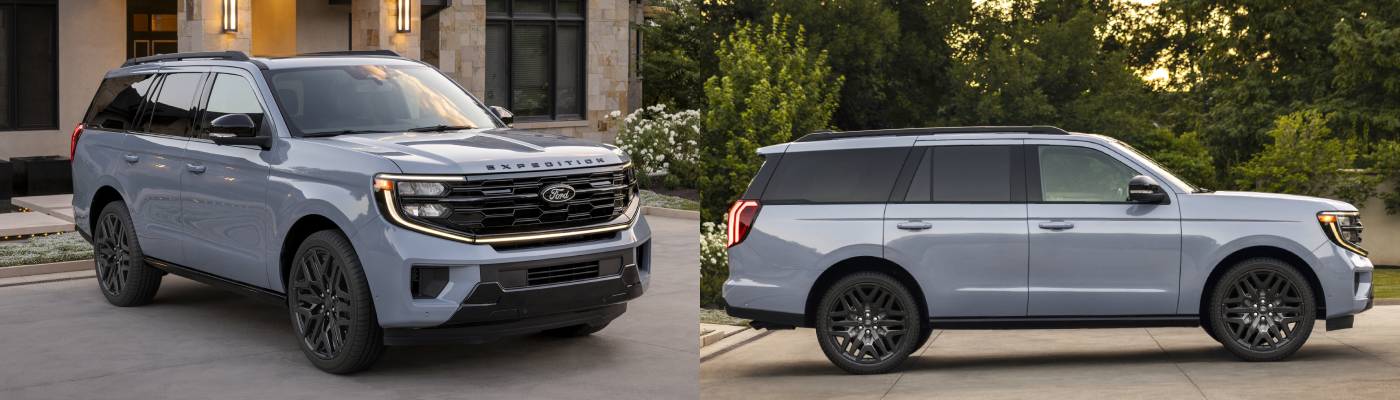
The 2026 Ford Expedition continues the fifth-generation design introduced for 2025, carrying forward its role as Ford’s largest passenger vehicle and the SUV counterpart to the F‑150. It retains three-row seating for up to eight passengers and offers standard and extended-length (Expedition Max) body styles. For 2026, Ford refines the Expedition’s tech suite, expands BlueCruise availability, and adds minor interior material improvements on upper trims. The split-opening tailgate, dual-screen cabin, and revised suspension tuning introduced last year remain. The Expedition continues to compete directly with the Chevrolet Tahoe/Suburban, GMC Yukon, Jeep Wagoneer, Nissan Armada, and Toyota Sequoia.
Under the hood, the 2026 Expedition keeps its proven 3.5‑liter twin‑turbocharged EcoBoost V6 in two output levels. The standard engine again delivers 400 horsepower and 480 lb-ft of torque, while the high-output version, an exclusive to Platinum and Timberline, remains at 440 hp and 510 lb-ft. Both engines pair with a 10‑speed automatic transmission and offer rear‑wheel or four‑wheel drive. Towing capacity is unchanged at a maximum of 9,300 pounds when properly equipped. Trims continue to include XL, XLT, Limited, Timberline, King Ranch, Platinum, and Tremor, though Ford adds new appearance packages for 2026.
Pricing increases slightly for 2026, starting around $63,000 for the base XL and reaching just over $88,000 for a loaded Platinum Max. Standard features remain generous, including the 13.2‑inch touchscreen, wireless Apple CarPlay/Android Auto, tri‑zone climate control, and Ford’s Co‑Pilot360 safety suite. The optional 24‑inch panoramic digital display receives software refinements for 2026, and BlueCruise hands‑free driving expands to more trims. The Platinum Ultimate Package continues to offer massaging seats, upgraded leather, and premium audio. Tremor and Timberline remain the off‑road leaders, while Limited continues to be the most balanced choice for families.
Engine Performance
The twin‑turbo V6 continues to deliver confident acceleration and strong passing power, especially in high‑output form. The standard engine reaches 0–60 mph in roughly 6.2 seconds, while the Platinum’s more powerful variant ups the ante to 5.7 seconds. The 10‑speed automatic transmission receives minor calibration updates for smoother low‑speed behavior, reducing the occasional downshift hesitation noted in the 2025 model. Whether merging, towing, or climbing grades, the Expedition maintains its composed and responsive character.
Fuel Economy
EPA ratings are 17 mpg city / 23 mpg highway / 19 mpg combined for rear‑wheel‑drive models, and 16 / 22 / 18 mpg for four‑wheel‑drive versions. Regular unleaded is recommended, and the 28.3‑gallon tank yields a highway range of about 620 miles. Real‑world fuel economy averages 17–18 mpg combined depending on load and driving style with steady-state highway numbers coming in around 21-23 mpg. While not class‑leading, the Expedition’s efficiency remains competitive among full‑size SUVs with turbocharged power.
All‑Wheel Drive & Off‑Road Capability
The 2026 Expedition’s 4WD system offers a two‑speed transfer case and Terrain Management System with modes including Normal, Sport, Tow/Haul, Eco, Slippery, Sand, and Mud/Ruts. Tremor and Timberline offer off‑road‑tuned suspension, skid plates, a limited‑slip rear differential, and 33‑inch all‑terrain tires. Ground clearance is10.6 inches, with strong approach and departure angles for trail use. For 2026, Ford adds a new optional front‑camera wash system on off‑road trims to improve visibility in muddy conditions.
Ride Quality
Ride quality remains a strong point for 2026. Suspension geometry and adaptive dampers carry over, delivering a smooth, controlled ride over rough pavement. Lower trims still ride firmer with standard coil springs, while higher trims equipped with adaptive suspension offer a more cushioned, composed feel. Max models excel at long‑distance comfort thanks to their extended wheelbase. Minor software refinements for 2026 improve damping transitions during rapid elevation changes.
Handling Characteristics
feel is light and tuned for ease rather than precision. Body roll is present but well managed for a vehicle of this size. Braking performance remains solid, with spongy pedal feel and inconsistent modulation. Stopping distances are longer than some rivals, but overall stability and confidence remain strengths. The Expedition continues to prioritize comfort and predictability over sporty dynamics.
Interior Noise Levels
Cabin isolation remains excellent for 2026. Higher trims receive slightly thicker door seals and improved wheel‑well insulation, further reducing road noise. Wind noise is minimal at highway speeds, and engine noise remains well muted under normal driving. Compared to the Tahoe and Sequoia, the Expedition continues to rank near the top for quietness, rivaled primarily by the GMC Yukon Denali.
Interior Design & Materials
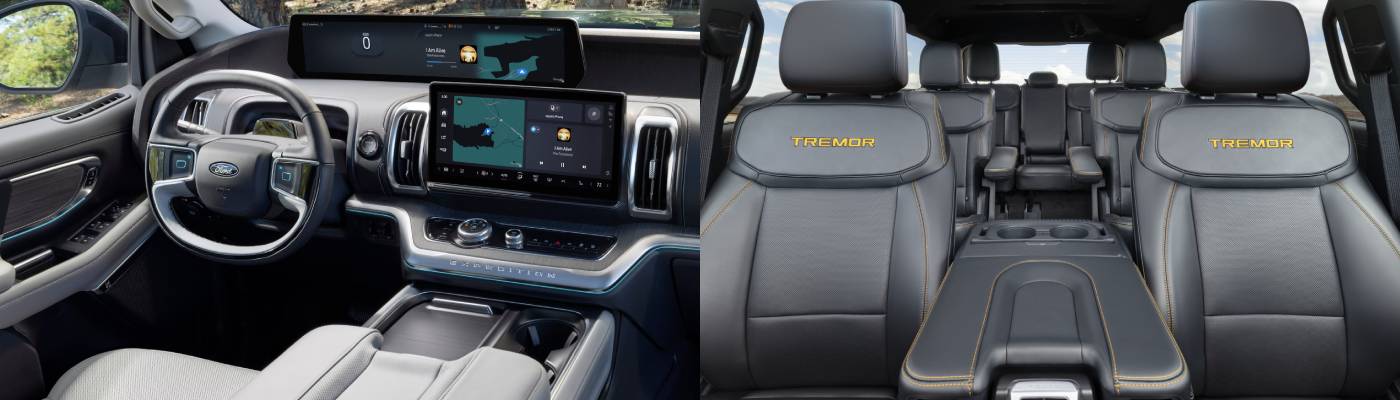
The interior design carries over, but Ford improves material quality on 2026 Limited and King Ranch trims with upgraded soft‑touch surfaces and revised stitching patterns. The dual‑screen layout remains a highlight, and the 24‑inch panoramic display receives smoother animations and better integration with Ford’s Digital Experience software. Storage solutions include a sliding center console and rear device holders. Overall, the cabin continues to feel upscale, modern, and functional.
Technology & Safety Features
Technology sees meaningful refinement for 2026. Ford’s Digital Experience platform receives faster processing, expanded app support, and improved voice recognition. Wireless smartphone mirroring, OTA updates, and Google‑based navigation remain standard. Safety features include adaptive cruise control, lane‑keeping assist, blind‑spot monitoring, rear cross‑traffic alert, and automatic emergency braking. BlueCruise availability expands to Limited and King Ranch trims for 2026, and the system gains smoother lane‑centering and improved handoff transitions.
Seating & Comfort
Seating configurations include 7 and 8‑passenger version with either a 3-person second-row bench or captain’s chairs available. Front seats offer heating, ventilation, and massage in upper trims. Second‑row legroom remains generous, and third‑row access via tip‑and‑slide seats is still easy. The third row accommodates adults comfortably with reclining seatbacks and ample headroom. Ford adds improved second‑row USB‑C charging speeds for 2026.
Cargo Capacity & Storage
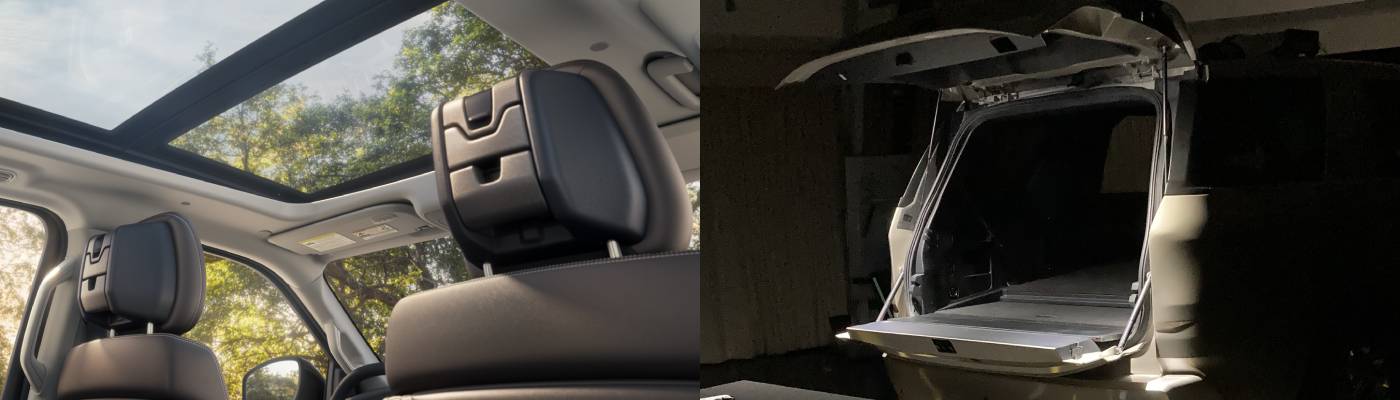
Expedition stands alone with the Chevrolet Tahoe/Suburban and GMC Yukon twins as the most capricious SUVs around. On standard models Expedition offers 20.9 cu. ft behind third row, 63.6 cu. ft. behind second row, and 104.6 cu. ft. with all seats folded. Expedition Max grows those numbers to 36/79.6/121.5 cu ft. Interior storage continues to include a deep center console, under‑floor bins, and abundant cupholders. USB‑C and USB‑A ports remain available in all rows, and the 110V AC outlet in the cargo area carries over. Unlike most competitors, the Expedtion offers a clamshell tailgate design. It is significantly more user-friendly than one large tailgate. Ford also offers a hidden and lockable storage area under the power sliding center console.
Bottom Line
The 2026 Ford Expedition builds on the strengths of the 2025 redesign with incremental improvements to technology, cabin materials, and BlueCruise availability. It remains more refined than the Tahoe, more versatile than the Sequoia, and more affordable than the Yukon Denali. Fuel economy, brake performance and steering feel remain mild weaknesses, but ride quality, cabin quietness, and tech integration continue to stand out. For most buyers, the Limited trim remains the best blend of luxury, features, and value, especially with the updated tech suite and optional Driver’s Package.