2026 Subaru Outback
The adventurous wagon that still outclasses the crossovers.
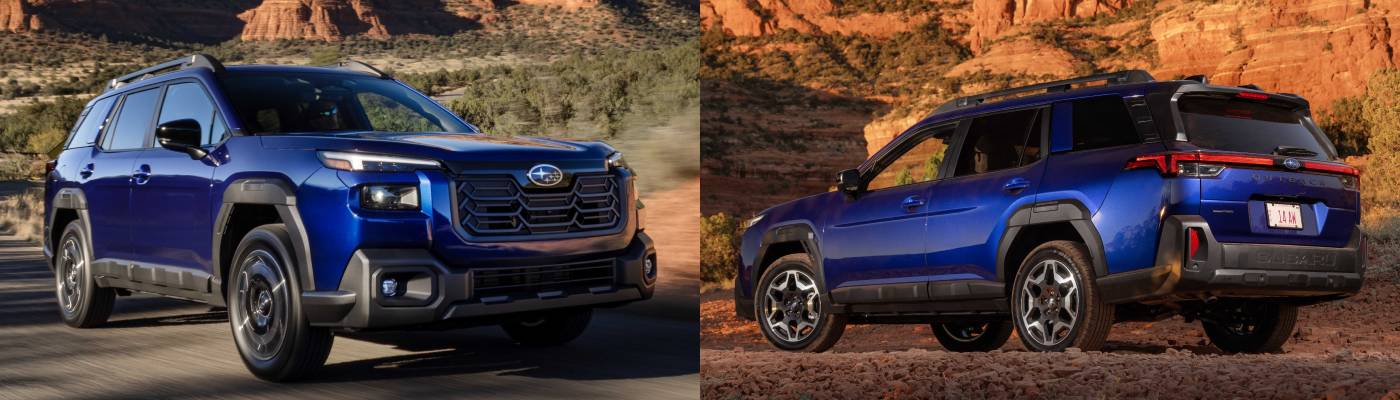
The 2026 Subaru Outback continues its long-running role as one of America's most recognizable crossover wagons, a model that helped define the rugged-wagon niche when it arrived in the mid-1990s. For 2026, Subaru gives the Outback a complete refresh but keeps the formula familiar: two rows of seating for five, a single wagon body style, and standard all-wheel drive across the lineup. Though many consider it a wagon, Outback's closest rivals are midsize crossovers like Honda Passport, Hyundai Santa Fe, Jeep Grand Cherokee, Kia Sorento, Nissan Murano, Toyota Venza, and Volkswagen Atlas Cross Sport. Subaru's Wilderness variant remains the most visually and mechanically distinctive model, aimed at buyers who want more off-road capability without stepping into a full SUV.
Trim levels for 2026 include Premium, Limited, Touring, Limited XT, Touring XT, and Wilderness. Two engines are offered: a naturally aspirated 2.5-liter flat-four producing 180 hp and 178 lb-ft, and a turbocharged 2.4-liter flat-four producing 260 hp and 277 lb-ft. Both engines pair with Subaru's Lineartronic CVT and come standard Symmetrical All-Wheel Drive. Towing capacity tops out at 3,500 pounds with the turbo engine. No hybrid or EV versions are offered for 2026.
Pricing starts at $34,995 for the Premium and rises to $47,995 for the Touring XT, with the Wilderness priced at $44,995. Standard features include Subaru's EyeSight driver-assist suite, dual-zone climate control, a power rear gate, and a large touchscreen infotainment system. Higher trims add leather upholstery, a Harman Kardon audio system, navigation, and a power moonroof. The Wilderness model adds off-road-oriented hardware such as all-terrain tires, a lifted suspension, and additional drive modes.
Engine Performance
The base 2.5-liter engine delivers adequate but not brisk acceleration, with modest passing at highway speeds. Drivers who frequently tow, merge or pass at speed will definitely want the turbocharged engine. The CVT behaves smoothly in everyday driving, but under heavy throttle it can hold revs in a way that emphasizes the engine's limited power reserves. Expect 0-60 mph times in the mid-8-second range-sufficient for commuting but not exciting.
The turbocharged 2.4-liter engine transforms the Outback's personality. With 260 hp and 277 lb-ft, it provides strong midrange torque and confident passing power. The CVT pairs well with this engine, simulating stepped shifts under hard acceleration and keeping the turbo in its sweet spot. Acceleration to 60 mph falls into the low-6-second range, making the XT and Wilderness trims feel genuinely quick for the segment. The Wilderness, despite its knobby tires and lifted suspension, still benefits from the turbo engine's broad torque curve.
Fuel Economy
EPA ratings for the 2.5-liter engine come in at 25 mpg city / 31 mpg highway, while the turbocharged XT models return 21 mpg city / 29 mpg highway. The Wilderness trim, with its off-road tires and lifted suspension, is rated at 21 mpg city / 27 mpg highway. All models use regular unleaded gasoline and share the same fuel tank capacity, yielding highway ranges between roughly 486 and 558 miles, depending on trim. Real-world fuel economy tends to align closely with EPA estimates, though the Wilderness often returns slightly lower numbers due to its more aggressive tires.
All-Wheel Drive and Off-Road Systems
Subaru's Symmetrical All-Wheel Drive is standard across the lineup and remains one of the brand's defining features. The system continuously varies torque distribution and works with X-MODE, which optimizes traction on slippery surfaces. Hill Descent Control is also included. The Wilderness trim adds extra drive modes, a lifted suspension, all-terrain tires, and enhanced cooling for off-road use, making it the most capable Outback for rugged terrain.
Ride Quality
Ride quality in the standard Outback trims is comfortable and compliant, with suspension tuning that absorbs bumps well without feeling overly soft. The Touring and Limited trims suffer from a bit more impact noise thanks to their wheel and tire combinations. The Wilderness, with its all-terrain tires and raised suspension, rides more firmly and transmits more road texture into the cabin, but the trade-off is improved capability on rough surfaces.
Handling
The Outback's handling is secure and predictable, but very vanilla. Steering feel and accuracy is especially bland. Body roll is noticeable in quick transitions, reflecting the vehicle's tall stance and comfort-oriented suspension tuning. Braking performance is stable, and the pedal feel is consistent, though not particularly sporty. The Wilderness model, with its off-road tires, exhibits more body movement and reduced grip on pavement.
Interior Noise
Interior noise levels are generally low, with wind and road noise well-controlled in most trims. The Wilderness is the exception, as its all-terrain tires generate more hum at highway speeds. Compared with competitors, the Outback is quieter than the Jeep Grand Cherokee and Kia Sorento but slightly louder than the Toyota Venza.
Interior Design and Materials
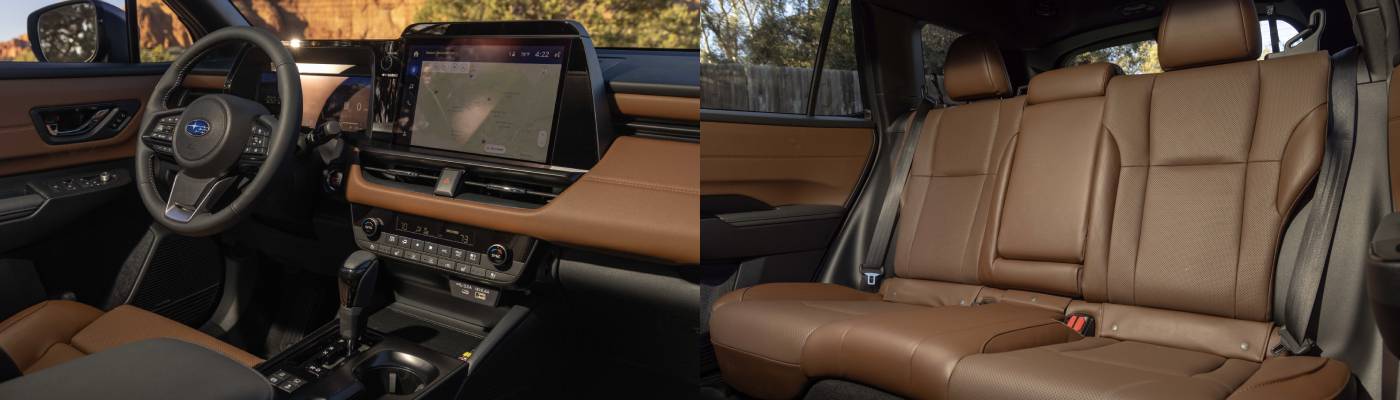
The cabin design emphasizes practicality, with a clean dashboard layout that ditches Subaru's signature vertical touchscreen for a still large display with traditional HVAC controls below. Materials improve as you move up the trim ladder, with the Touring models offering soft-touch surfaces and upscale finishes. The Wilderness uses more rugged materials designed to withstand outdoor use.
Interior Functionality
Controls are logically arranged, and the infotainment system is straightforward and climate functions are now separated, for the most part. Visibility is excellent thanks to large windows and thin pillars, making the Outback easy to maneuver.
Technology & Safety
Every Outback includes Subaru's EyeSight suite, which bundles adaptive cruise control, lane centering, forward collision warning with automatic braking, blind-spot monitoring, and rear cross-traffic alert. Outback also features a driver-attention system. While a significant safety upgrade it constantly pings warnings under normal driving conditions. Higher trims add navigation, a premium audio system, and a digital instrument cluster.
Seating
The Outback seats five, with generous headroom and legroom in both rows. Front seats are supportive on long drives, while the rear bench offers adequate space for adults. Entry and exit are easy thanks to a moderate step-in height. No third row is available.
Cargo Capacity
Cargo capacity is a strong suit, with 80.5 cubic feet available with the rear seats folded. Behind the second row, space is generous enough for luggage, camping gear, or home-improvement supplies. Interior storage is plentiful, and USB ports are available in both rows.
Bottom Line
The 2026 Subaru Outback remains one of the most versatile vehicles in its class, blending wagon-like practicality with SUV-like capability. Its strengths include standard AWD, excellent cargo space, strong safety tech, and the availability of a powerful turbo engine. The Wilderness trim stands out as a unique offering, providing real off-road capability without sacrificing everyday usability. Weaknesses include modest acceleration from the base engine and slightly higher cabin noise in the Wilderness.
Against competitors, the Outback offers a compelling mix of features, performance, and value. The best overall trim for most buyers is the Limited XT, which pairs the stronger turbo engine with a rich set of comfort and safety features at a reasonable price point.